

Fire Ant Control in Clayton, NC
Clayton's warm, humid growing season creates ideal conditions for fire ant colonies to establish and spread rapidly across residential properties, with activity peaking from spring through early fall. Rigby Pest Control connects Clayton property owners with local pest control providers who understand the timing and persistence of fire ant problems in this region. Getting a qualified local provider on the problem quickly can prevent painful stings and protect your family and pets from established colonies.
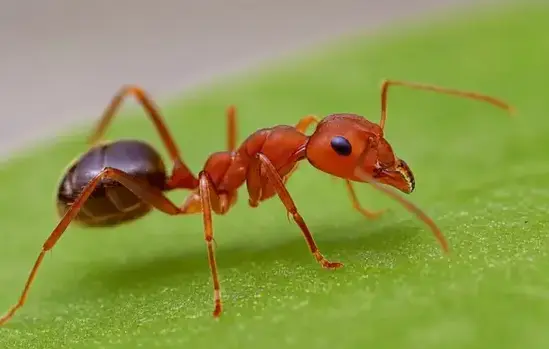
When are fire ants active in Clayton, NC?
Two things decide when you see a pest: what the species does, and what the weather here actually does. Below is the published guidance on the first, set against this city's own measured climate.
“Foraging activity slows when soil temperature is lower than 65 to 70 °F or higher than 90 °F.” UGA Extension
“Mating flights are most common in spring and fall.” UGA Extension
Because that is a temperature rule rather than a date, it can be read directly against the local figures below — the months that cross 90 °F are the months when foraging slows at the top end.
Clayton averages 14.9 days at or above 90 °F in July — the stretch when UGA's upper limit is being crossed — and 40.9 such days across the year.Source: NOAA 1991-2020 Climate Normals, CLAYTON WTP, NC US station (0.8 mi from Clayton)

Fire Ant Control Solutions for Clayton Homeowners
Clayton's warm, humid Piedmont climate creates ideal conditions for fire ants to thrive, particularly as temperatures rise through spring and summer months. These aggressive colonies can establish themselves quickly in yards, gardens, and around home foundations, posing a genuine threat to families and pets. Fire ant activity remains elevated throughout the warmer seasons in Clayton, and without intervention, infestations can spread across a property and become difficult to manage. The combination of moisture and warmth that characterizes the region means fire ants are not a seasonal nuisance for most homeowners—they're an ongoing concern that demands prompt, effective treatment.
Rigby Pest Control connects Clayton property owners with local, independent pest control providers who specialize in fire ant control and understand the specific challenges these insects present in the area. The providers in our network use targeted approaches designed to eliminate active colonies and prevent reinfestation, with follow-up care built into their service plans to ensure lasting results. Rather than guessing at treatment timing or relying on temporary fixes, these professionals develop strategies tailored to your property's layout and the extent of the infestation. When you reach out to Rigby, you're matched quickly with a local provider ready to assess your fire ant problem and move forward with a solution.
Why Clayton Homeowners Choose Rigby for Fire Ant Control
Local Fire Ant Expertise
Rigby connects you with independent providers who understand fire ant behavior and seasonal patterns in Clayton's Piedmont region, ensuring targeted fire ant control strategies that work where you live.
Fast Fire Ant Response
Active fire ant colonies demand quick action. Rigby's local provider network responds promptly to fire ant infestations, minimizing the time colonies spend near your home and family.
Clear Fire Ant Treatment Plans
Fire ant control requires transparency. Rigby connects you with providers who explain their fire ant treatment approach upfront, answer your questions, and keep you informed throughout the process.
Spring-to-Fall Fire Ant Pressure
Clayton's warm growing season intensifies fire ant activity from spring through early fall. Rigby's local providers understand this seasonal cycle and help you protect your property during peak fire ant months.
How Our Fire Ant Treatment Works
Schedule Your Fire Ant Control Visit
Contact Rigby Pest Control to describe your fire ant problem in Clayton, and we'll connect you with a local independent provider who can assess your property. They'll arrange a convenient time to inspect for mound activity and determine the scope of your fire ant infestation.
Fire Ant Assessment & Treatment Plan
The local provider will evaluate your yard for active fire ant colonies, identify conditions favoring their spread, and recommend a customized fire ant control strategy. In Clayton's warm growing season, fire ants remain highly active from spring through early fall, making prompt treatment critical to prevent colony expansion.
Fire Ant Control & Monitoring
The provider will apply fire ant control measures to target colonies on your property and discuss follow-up steps to prevent reinfestation. They'll advise on ongoing monitoring to catch new fire ant activity early, especially as seasonal conditions support renewed colony establishment.
Ready to get rid of fire ants in Clayton? A local provider can get started fast.
Call (919) 913-7669Fire Ant Control Across Clayton Properties
Clayton's warm, humid Piedmont climate creates persistent conditions for fire ant activity, particularly from spring through early fall when colonies are most aggressive and visible. Properties throughout the area—from established neighborhoods like Downtown Clayton with mature trees and older structures to newer developments such as Flowers Plantation—face similar seasonal pressure. Mature landscaping and dense vegetation can provide ideal nesting sites, while foundation gaps and entry points in aging homes may allow easier indoor access during peak seasons.
Year-round monitoring matters in Clayton because fire ant populations don't disappear entirely during cooler months; they simply retreat deeper into the soil and remain a dormant threat. Whether your property sits in a densely wooded lot or a more open residential setting, early detection and professional treatment prevent small colonies from expanding into widespread infestations. Local providers connected through Rigby Pest Control understand Clayton's specific seasonal patterns and can recommend timing and strategies that address fire ant activity before it becomes a safety concern for your family, pets, or outdoor spaces.
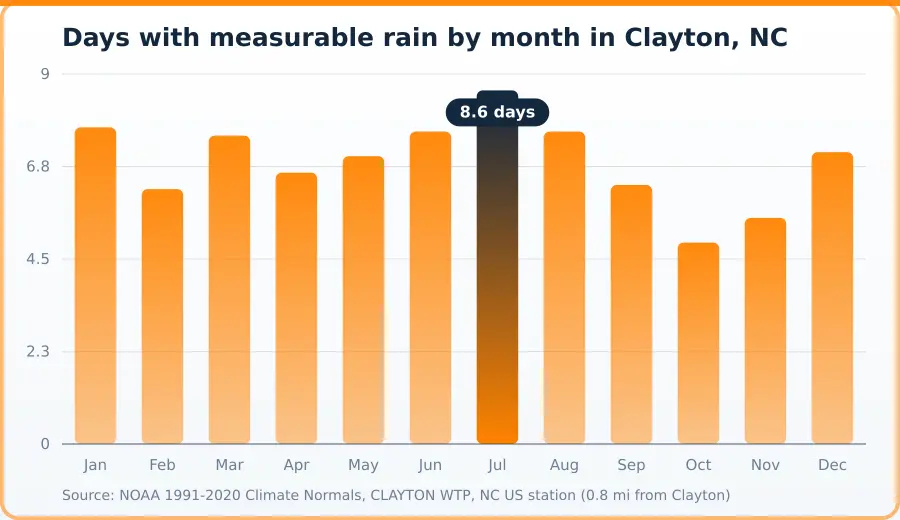
| Period | Days with measurable rain by month (days) |
|---|---|
| Jan | 7.7 |
| Feb | 6.2 |
| Mar | 7.5 |
| Apr | 6.6 |
| May | 7 |
| Jun | 7.6 |
| Jul | 8.6 |
| Aug | 7.6 |
| Sep | 6.3 |
| Oct | 4.9 |
| Nov | 5.5 |
| Dec | 7.1 |
Source: NOAA 1991-2020 Climate Normals, CLAYTON WTP, NC US station (0.8 mi from Clayton). Retrieved October 5, 2026.
Fire Ant Control Across Clayton's Four Seasons
Spring: Peak Emergence
As Clayton's last spring freeze typically arrives around April 7, fire ants emerge from winter dormancy right as soil warms and nesting activity accelerates. Queens begin laying eggs aggressively, and colonies expand rapidly—making spring the critical window to establish control before populations explode. Rigby Pest Control connects property owners with local providers who understand this urgent timing and can deploy targeted treatments before mounds become deeply established across yards, gardens, and Riverwood's residential spaces.
Summer: Intense Nesting
Summer heat amplifies fire ant reproduction and aggression; Clayton averages nearly 15 days above 90°F in July alone, creating ideal conditions for multiple brood cycles and expansion. Colonies grow larger and more defensive, and workers forage more actively, increasing sting risk to residents and pets. Rigby Pest Control helps homeowners connect with providers who can adjust treatment frequency and method during these months of peak ant pressure, ensuring protection when exposure is highest.
Fall: Preparation and Persistence
Fire ants do not die off as temperatures drop toward Clayton's first autumn freeze around November 3; instead, they consolidate and deepen mounds to survive winter. August and September still bring 2.8 days above 90°F, sustaining colony vigor into early fall. Rigby Pest Control connects property owners with local providers who recognize that fall control efforts are essential—treating now prevents entrenched populations from surviving the cold and re-emerging even stronger the following spring.
Winter: Dormancy and Underground Threat
Winter cold in Clayton does not eliminate fire ants; colonies simply move deeper underground and slow reproduction. Though visible activity drops, ants remain alive and organized beneath the surface, waiting for spring warmth. Rigby Pest Control helps homeowners understand that winter is an overlooked opportunity—providers can apply soil treatments now that reach deep nests and create lasting barriers before the spring surge begins again.
Related Services
Fire Ant Control FAQs — Clayton, NC
Fire ant control typically includes locating active mounds on your property and applying targeted treatments to eliminate colonies at the source. The independent local provider you're connected with will assess the infestation's extent and recommend a strategy suited to your yard's layout. Treatment may involve mound injections, broadcast applications, or bait systems designed to reach the queen and disrupt the colony.
Rigby works to connect you with a local fire ant control provider in Clayton as fast as possible. Once you submit your request, we match you with an independent provider in your area who can discuss timing and availability. Response times depend on current demand, but local providers typically reach out promptly to schedule your service.
Fire ant control pricing depends on several factors, including the number of mounds on your property, the size of your yard, how long the infestation has been active, and the treatment method recommended. The independent provider you're matched with will assess your specific situation and explain pricing during a consultation—costs vary based on the scope of work needed.
Before treatment, the provider will give you specific preparation instructions. Generally, you may need to clear debris from mound areas, keep pets and children away during application, and follow any safety guidelines for pesticide use. After treatment, the provider will advise on when it's safe to re-enter treated zones and how to monitor for results over the following weeks.
While fire ant reinfestation is possible, ongoing prevention helps reduce risk. Keep your lawn well-maintained, remove food sources like pet debris, and promptly address any new mound activity. The provider you work with can recommend follow-up inspections or maintenance treatments to catch colonies early before they establish, especially during peak activity seasons.
Fire ant activity intensifies during Clayton's warmer months, with spring through early fall being the period of heaviest pressure. Treating colonies during active season is often most effective, though ant activity continues at lower levels year-round. Starting treatment as soon as you notice mounds gives you the best advantage before populations peak.
Homeowner Safety Toolkit
Verify Your Clayton, NC Pest Control Company
Before you hire anyone, use these independent national resources to confirm credentials, standards, and track record.
NPMA
QualityPro is the pest control industry's own accreditation program, endorsed by the National Pest Management Association. Find and verify a company's accreditation before you hire.
Find a Certified ProBBB
Look up any pest control company's complaint history, customer reviews, and accreditation status — a free, independent check before you hire.
Check StandingEPA
The federal government's own guide to choosing a pest control method and using pesticides safely around your home and family.
Pesticide Safety GuideDealing with fire ants in Clayton? Get fast, targeted treatment from a local provider.
Call (919) 913-7669Areas We Serve in Clayton, North Carolina
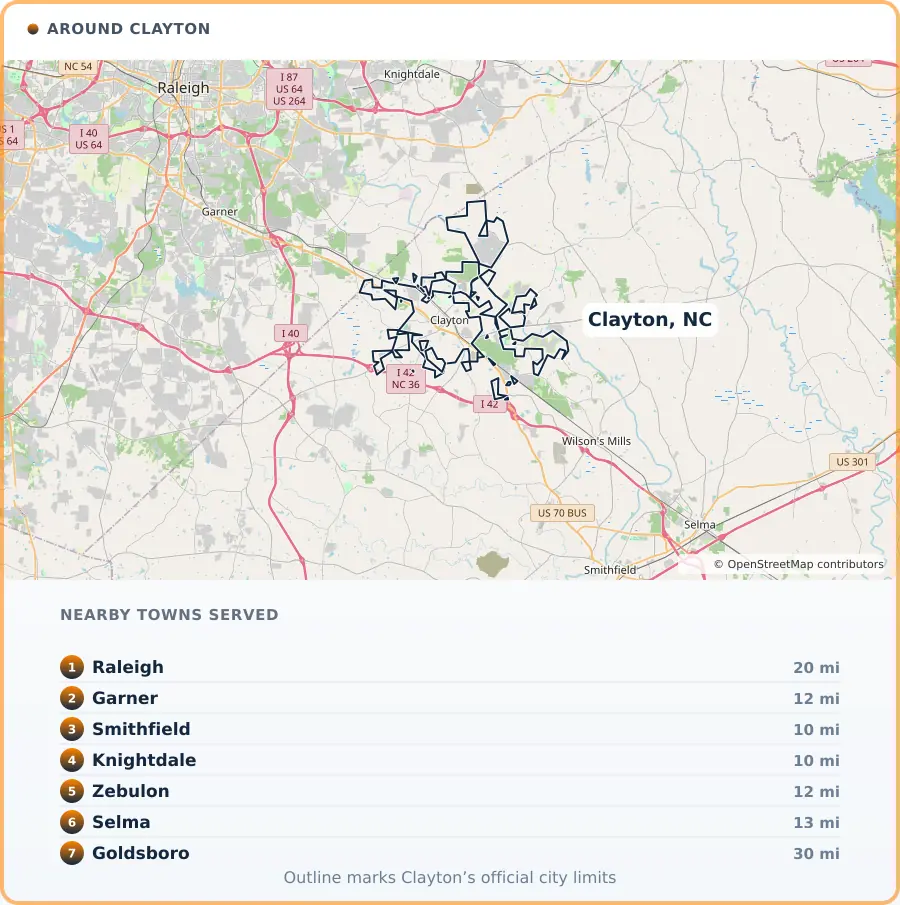
Coverage centres on Clayton, NC and reaches 7 surrounding communities. Response time is what matters most in the hours after a problem is found, so knowing the ground is part of the job.
Clayton, NC Information
Just outside Raleigh, Clayton, NC has grown from a quiet crossroads town into one of the fastest-changing communities in the Triangle, with roughly 28,000 residents calling it home. That growth shows in neighborhoods like Flowers Plantation and Downtown Clayton, where new rooftops and small businesses keep springing up alongside longtime fixtures.
The local economy runs on a sturdy mix of industries: pharmaceutical and biomanufacturing giants like Novo Nordisk and Grifols, heavy equipment maker Caterpillar, and steady employment from UNC Health Johnston, Johnston County Public Schools, and area retailers. Add in agriculture roots that still shape the surrounding countryside, and you get a town that feels both rooted in its rural past and firmly plugged into the region's modern momentum.

Photo: Chris Light, CC BY-SA 4.0